What Makes a Good Project
Eight elements to guide great project design

Teachers instinctively know that projects are worthwhile, even if they do not understand every facet of a good project or have experience supporting project-based learning. For too many students, the term “project” means any activity that is not worksheet-based or takes longer than a 42-minute class period. I have seen too many instances of unimaginative assignments turned into projects just by giving students weeks for completion. That five paragraph essay about caribou is transformed into a project when students are given two months to obsess over it. The inevitable procrastination leads to increased stress and an imperceptible improvement in quality.
The protean nature of computers as constructive material with which you may explore powerful ideas and express yourself in a myriad of ways makes a wider range and depth of projects possible like never before. The Constructivist Consortium is committed to using computers in creative ways in which interdisciplinary projects demonstrate student competence and connect knowledge domains. Open-ended software supports learning diversity and allows multiple entry points into a sea of ideas. Seymour Papert once said, “If you can make things with computers, then you can make a lot more interesting things.”
Making things is better than being passive, but making good things is better still!
The Constructivist Consortium believes in Papert’s theory of constructionism; the idea that the best way to construct knowledge, or understanding, is through the construction of something shareable, outside of a student’s head. Those artifacts are commonly thought of as projects, even though the project development process is where the learning occurs. Such artifacts are evidence of learning.
Elements of a Good Project
Purpose and Relevance
Is the project personally meaningful? Does the project prompt intrigue in the learner enough to have him or her invest time, effort, and creativity in the development of the project?
Time
Sufficient time must be provided for learners to think about, plan, execute, debug, change course, expand, and edit their projects. Class time affords students equal access to expertise and materials; projects may also need sufficient out-of-school time.
Complexity
The best projects combine multiple subject areas and call upon the prior knowledge and expertise of each student. Best of all, serendipitous insights and connections to big ideas lead to the greatest payoff for learners.
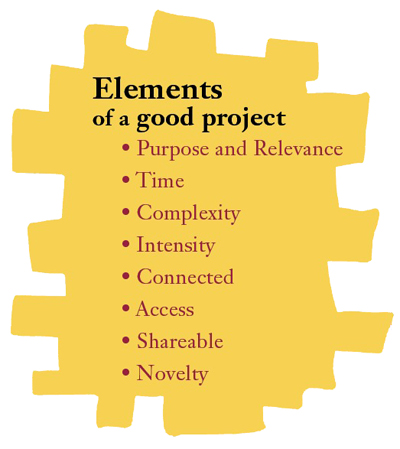
Intensity
Children have a remarkable capacity for intensity that is rarely tapped by the sliced-and-diced curriculum. Projects provide an outlet for the exercise of that intensity. Think about how long kids can spend mastering a video game, reading a favorite book series, memorizing the attributes of Pokemon, or building a tree house, and you have a good template for successful project-based learning.
Connected
During great projects students are connected to each other, experts, multiple subject areas, powerful ideas, and the world via the Web. The lessons learned during interpersonal connections that are required by collaborative projects last a lifetime.
While there is some merit in organizing student groups to “teach” collaboration, I prefer a more natural environment in which students collaborate (or do not) based on their own needs.
Collaboration may consist of observing a peer, asking a quick question, or by working with the same teammates for the duration of a project.
Access
Students need access to a wide variety of concrete and digital materials anytime, anyplace. Personal student laptops make this possible, but we also need to think about the quality and quantity of craft materials, books, tools, hardware, software, and Internet access that allows learners to follow paths we may never have anticipated.
When nonconsumable materials are used, such as LEGO, a sufficient quantity is necessary to ensure that students have everything they need for their projects and can leave the finished products together long enough for others to learn from them. The last thing you want is one student cannibalizing a classmate’s work during project creation.
Shareable
This is the big idea of project-based learning! Students need to make something that is shareable with others. This provides a great deal of motivation, relevance, perspective making, reciprocal learning, and an authentic audience for the project.
Novelty
Few project ideas are so profound that every child needs to engage in its development in every class, or year after year. Yes, that means that it may be time to rethink the annual marshmallow adobe project. If one student makes a fantastic discovery during a project, others can learn from it without slavishly repeating the steps of the pioneering student. In a healthy community of practice, learning continues and knowledge is shared naturally without coerced repetition.
“A project is something you want to share” is a sufficient definition for learners of all ages.
Questions Worth Asking
Is the problem solvable? Projects often begin with a problem statement. Too many school projects are based on problems unsolvable by students. That is not always a bad thing, since a student might learn a lot before appreciating the enormity and complexity of a problem. That is a worthy outcome in itself. Completely solving a problem about fixing a levee may be too advanced for Kindergartners, but they could learn the complexity of the problem and gain an appreciation for the other things they need to learn. Asking kids to solve world peace is a dopey project idea because they can not get their heads or arms around such ill-defined, infinitely complex problems.

Requiring students to assume the role of people with whom they share no life experience causes other problems. This is why conference panel discussions asking school students to invent the future of education leads to a stream of banalities and audience boredom.
The brilliant educators of Reggio Emilia, Italy, teach us that a well-designed, open-ended, learner-definable prompt is the best starting place for project-based learning. Rather than ask, “How would you make the world a better place?” Reggio educators might ask three year olds, “Can you make a park for the birds who come to visit our school?” Kids immediately have a starting point they can wrap their heads around. They know about birds and parks and can build all sorts of representations. In the process they learn about birds, measurement, engineering, and collaboration and develop a plethora of powerful ideas no teacher is smart enough to anticipate.
Is the project monumental or substantial? Schools require kids to produce all sorts of monumental work, like that work sheet featuring 200 similar arithmetic problems. The goal is substantial work, where a student wants to engage and may exceed our expectations. The goal of school should be for students to engage in substantial work.
Who does the project satisfy? Is the learner as enthusiastic a beneficiary of the project as the person giving her a grade? Great projects benefit the learner more than the teacher.
What can they do with that? Seymour Papert taught me that anything you ask of a student should lead to the construction of a more complex question or a larger theory. Otherwise, we should rethink the assignment. Great projects, like hobbies, have a self-regulating feedback loop. Incremental success motivates a student to try something more ambitious or to enhance the project. Bugs or mistakes lead students to rethink problems and test new strategies. Powerful learning occurs in both instances.
Making Memories
Ever woken up late on a Saturday morning and realized that you have no milk for your coffee? You pull a coat over your pajamas, put on a hat, and run to the local Kwickie Mart. Just as you are leaving the store unrecognized, a former student sees you from across the parking lot. She comes rushing towards you and your unbrushed teeth with arms outspread and gives you an awkward hug. The former student wants to reminisce. She enthusiastically begins a sentence, “Remember that time we…” The rest of the sentence is never “crammed for the standardized test” or “used all of our spelling words in one big stupid sentence.” The student’s reminiscence always concludes with a description of a project.
Projects are what students remember long after the bell rings. Great teachers know that that their highest calling is to make memories.

Dr. Gary Stager (@garystager) has spent the past 26 years as an internationally recognized educator, speaker, and consultant. He is co-author of Invent To Learn: Making, Tinkering, and Engineering in the Classroom

 Most Read