Iconic Pattern Play
Building cognitive skills through physical and technical play.

Our society is slowly re-awakening to the realization that physical, creative, constructive, and imaginative play have an extremely important function for the healthy growth of children’s bodies, minds, and spirits.
We need to inspire and support play because it is so powerfully appealing to children’s sense of fun, to their imaginations, to their creativity, to their thoughtfulness, to their sense of wonder, and to their joy of accomplishment and achievement.
Many years of working with teachers and children sharing hands-on experiences with an incredible range of recycled materials have shown us that unstructured, child-initiated creative play can strongly contribute to children’s growth and development. Our recent experiences with creative technology tools has led us to develop a combination of physical and computer-based play activities that support healthy cognitive development.
Creative Play with Unstructured, Recycled Materials
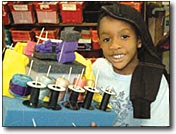
Rich, stimulating, hands-on experiences create the necessary conditions for optimal mental development and set the stage for the introduction of higher order thinking skills in a variety of forms. Using materials donated by local businesses, thereby expanding their recycling and “green” programs, Walter has engaged the hands, hearts, and minds of children through their fingertips. Children think, plan, and observe what happens as they use these interesting discarded objects to count, sort, stack, build, and create art.
By simply fiddling around with and exploring a wide range of materials, children practice a wealth of brain-boosting skills that will serve them in school and throughout life. Making something no one has ever seen before requires imagination, vision, creativity, problem solving, and patience. Coping with the endless possibilities available through play builds the power to think and the ability to create harmony and order. Children who are skilled at play with both things and ideas are more receptive to ambiguity and more likely to envision multiple possibilities or solutions to problems.
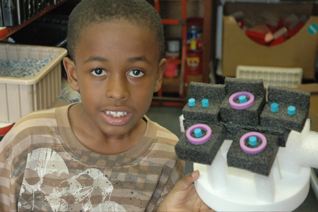
As children engage in creative play, two things happen: their attention to the possibilities of the materials changes and expands, and their intention transforms and develops into a self-reinforcing learning experience. As they begin to create, they “make meaning,” which is to say that through their direct intention, they create a physical manifestation of their new knowledge. In this way children come to understand and believe that they have within themselves the power to organize and control materials and events in a satisfying and fulfilling manner.
As play opportunities increase, so does the capacity to pay attention to possibilities. This interactive process between the perception of expanding possibilities and the growing realization of intention is generally what we mean by creativity.
Iconic Pattern Play with Cameras and Computers
The intentions that are revealed by children in their constructive creations can generally be organized into several common categories. For example, the intention can often take the form of a:
- Story – using the materials in a way that supports a story line.
- Function – using the materials in a way that fulfills that function, like a chair or a house.
- Structure – using the materials to create a structure, like a tower that is as high as possible.
- Pattern – using the materials to develop and explore a pattern.
It is through patterning, which often occurs throughout all forms, that we have made a strong connection to technology.
In 1985, Henry designed a computer program called Pattern Maker that enabled children to create rich and complicated patterns from simple geometric shapes. Watching learners play with patterns, we saw how the computer supported the mind at play, encouraging students to ask “what if” questions that would not likely be considered in the real world, and enabling them to pay attention to even MORE possibilities!
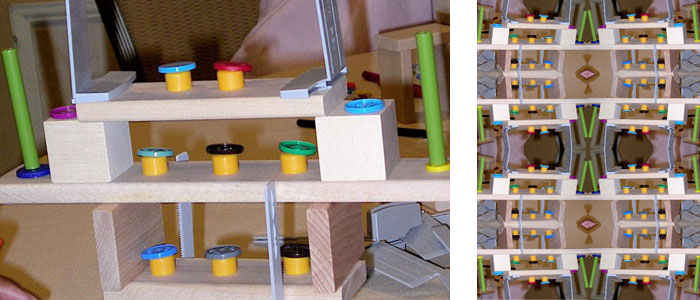
To extend the physical play in Walter’s workshops, we added a computer component to give students another window for viewing and extending their own creations. After creating something with open-ended materials, students took several pictures of their creation, chose one picture, and cropped it so that only a pattern remained. This cropped image became a new pattern play piece that the students used as a building block in a pattern composition program such as Pixie or Wixie. As they build totally new and fascinating patterns, students participate in what we call iconic pattern play.
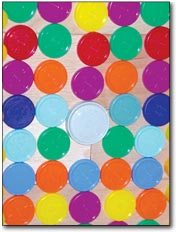
Rarely do children get to work in an environment where there is total abundance available for their play. For most children, the world of real objects is generally limited, like a set of blocks with a specific number of pieces. But technology provides the opportunity for a significant level of abundance. Once students have created their pattern play piece, they can make as many patterns as they want, exploring repetition and variation.
Patterning on the computer builds awareness that creative surprises are just around every corner and makes dreaming and imagining even more likely. It fosters and encourages experimentation in an environment where the risk factor is substantially reduced. Trying out ideas is faster and easier and mistakes or wrong turns are easily undone, so students can try any “crazy” idea that pops into their mind.
Iconic Pattern Play opens the mind to a whole new world of possibilities. As they play, students expand their intentions and gain confidence in their creative process.
Building Cognitive Skills
Iconic pattern play not only appeals to our aesthetic appreciation of beauty, but also to our cognitive understanding of structure. Using technology to play actively with patterns engages the mind of the learner in thinking about the relationships among the pattern play pieces he/she is using. Their growing understanding of those relationships leads to thinking about the process and method that links pieces together in particular ways.
Tests of mental ability frequently challenge students to recognize how a pattern is evolving over several iterations. Iconic pattern play provides a delightful way for learners to begin to explore and understand some basic elements of geometric patterns, like rotation, reflection, and displacement. Using technology with pattern play pieces enables the learner to play with different images and also to develop his/her understanding of process.

This happens because technology encourages the learner not just to make one and then another, but rather to make one, and then make another that is different in some regular way. The learner mentally connects the two patterns to achieve a desired effect. As this is repeated and evolves, the learner grasps the process involved, and begins to understand how alterations in the process lead to different results.
Cognitive psychologists talk about this attention to process as meta-cognition—that is, the capacity to think about one’s own thinking or creative process. Using technology for iconic pattern play begins to engage young learners in this kind of mental activity. Iconic pattern play also fosters a student’s ability to make predictions and test them, a fundamental process of science. The more learners play with patterns, and the more their processes for playing expand and become refined, the better able they are to make accurate predictions about how things will turn out. And, when the results deviate from the prediction, they are better able to understand why and make adjustments the next time around.
Other Dimensions
When learners begin to realize the pleasure of playing with pattern images and recognize that the world is abundant with fascinating patterns that can be captured with their powerful little digital cameras, a whole new set of possibilities opens up. And, more important for their learning on both aesthetic and cognitive levels, their view of their world changes and grows in remarkable ways. Their newly pattern-sensitive eye sees the world in an increasingly detailed and thoughtful way, enabling observations and predictions that were not even possible before. The resulting iconic pattern play creations that evolve are both exciting and highly compelling. What better way for young people to come to a fuller understanding of their world!





 Most Read