Community Banners
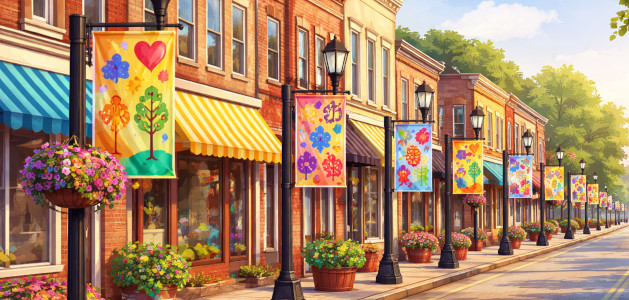
Students design banners that celebrate the community they call home.
Task
Every community has stories, traditions, and strengths that make it unique. These ideas often show up in banners, quilts, murals, and flags that celebrate who people are and what they value.
In this project, students explore the people and places that shape their community, learn how images can show culture and identity, and then design a banner that celebrates the strengths, traditions, and hopes of the community they call home.
Engage
The first step is to get students out into and thinking about the community where they live.
Read a picture book like Juanita by Leo Politi or Last Stop on Market Street by Matt de la Peña. Compare the communities in these stories with your own with the goal of helping students decide what makes their community unique.
If your school is centrally located, take a walk through the neighborhood or plan a more formal field trip to a local park or museum.
Guest speakers are another great way to connect to the people who live and work in your community and keep it running. Invite a parent in to speak about their job and where the work. You can use guest speakers to tie to other themes you are studying such as:
- government - city council member
- geography and nature - park ranger
- health - doctor, nurse, or EMT
As you discuss and explore you community keep a list of places and people and collect artifacts that represent those things like flyers, menus, and photos.
Provide these words, pictures and artifacts in a center in your classroom and provide students time to touch, discuss, and organize them.
Create
After they have explored and had time to think more deeply about your community, let students know they will be designing banners to celebrate what makes their community special.
Young students can design a banner around their favorite part of their community, but challenge older students to identify and celebrate things that make your community memorable or different from other places.
- The animals that live there?
- The celebrations you have?
- The special buildings, parks, and geographic features?
Ask students to write down or verbalize what they want to add to their banner design.
Then, provide 11x17 sheets of paper for them to design their banners and provide crayons, markers, or paint. Now would be a great time to partner with your art teacher!
If you have access to a digital tool, like Wixie, have students start a blank page in the portrait orientation and use the paint tool and image options to create a picture or collage.
Share
Display banners in hallways, create a digital gallery for families, share during a community night or assembly. Better yet, work with a community partner to display them beyond the school walls! While you may not make them highly visible along a city street, you may be able to partner with a local library, community center, or even city hall to display their work.
Ask each student to talk about what they included and why. Encourage students to look at the banners of classmates to discover similarities and differences that show how many cultures and stories can come together to create one strong, welcoming place.
Assessment
Throughout the project, notice how students talk about identity, culture, and community. During early conversations, listen for whether they can describe what makes their community special beyond places and objects.
While they design, ask students to explain what each part of their banner represents and how it connects to community strengths. For summative assessment, review each banner and accompanying explanation to see whether students communicated ideas about culture, belonging, and pride, and whether they used visual choices thoughtfully to share meaning.
Resources
Matt de la Peña. Last Stop on Market Street. ISBN: 978-0698173354
F. Isabel Campoy & Theresa Howell. Maybe Something Beautiful: How Art Transformed a Neighborhood. ISBN: 978-0544357693
Leo Politi. Juanita. ISBN: 978-0892369911
Susan Verde. Hey, Wall: A Story of Art and Community. ISBN: 978-1481453134
Standards
C3 Standards for Social Studies
D2.Civics.2.K-2.
Explain how all people, not just official leaders, play important roles in a community.
D2.Civics.6.K-2.
Describe how communities work to accomplish common tasks, establish responsibilities, and fulfill roles of authority.
D2.Civics.10.K-2.
Compare their own point of view with others; perspectives.
D2.Geography.6.K-2.
Identify some cultural and environmental characteristics of specific places.
ISTE Standards for Students:
4. Innovative Designer
Students use a variety of technologies within a design process to identify and solve problems by creating new, useful or imaginative solutions. Students:
a. know and use a deliberate design process for generating ideas, testing theories, creating innovative artifacts or solving authentic problems.
6. Creative Communicator
Students communicate clearly and express themselves creatively for a variety of purposes using the platforms, tools, styles, formats and digital media appropriate to their goals. Students:
a. choose the appropriate platforms and tools for meeting the desired objectives of their creation or communication.
b. create original works or responsibly re-purpose or remix digital resources into new creations.
d. publish or present content that customizes the message and medium for their intended audiences.

Melinda Kolk is the Editor of Creative Educator and the author of Teaching with Clay Animation. She has been helping educators implement project-based learning and creative technologies like clay animation into classroom teaching and learning for the past 15 years.




 Most Read